
DELIVER America took place in Las Vegas on October 7 and 8, bringing senior retail, brand, supply chain, and logistics leaders together with solution providers. The sessions stayed close to the operational decisions shaping 2027 plans. This recap draws on the event’s published program and keynote remarks, and focuses on what retailers, brands, and supply chain teams can act on.
Volatility Is the New Operating Model
The opening keynote panel, “Volatility Is Here to Stay,” featured Abe Eshkenazi, CEO of ASCM, Gopal Pal, Director of Operations at Target, and Alex Baker of Retail Tech X. The framing in the program was that tariffs, cost pressure, demand swings, and service promises are all moving at once, forcing retailers to rethink how they plan, price, source, and protect availability in real time.
A companion roundtable brought that pressure down to specific decisions: what to absorb, what to pass on, what to redesign, and which delivery promises a business can still afford to make. Topics included tariff exposure, margin protection, sourcing flexibility, inventory buffers, and scenario planning. Taken together, the two sessions pointed away from planning around a single forecast and toward scenario planning that ties sourcing, pricing, and customer promises together.
Fulfillment Is a Competitive Lever, Not a Back-Office Function
Tom Killeen, COO of THG, delivered the keynote, “Powering Brand Growth Through Intelligent Fulfillment.” His argument: proprietary fulfillment technology, automation, and robotics can sharpen operational efficiency, elevate customer experience, and turn logistics into a genuine competitive advantage.
“Fulfillment and operational services become so intrinsic to the success of any brand that it’s no longer the afterthought. You have to get it right,” said Killeen.
In practice, that puts fulfillment at the table when growth plans are set, rather than downstream of them.
Anticipate Demand Instead of Reacting to It
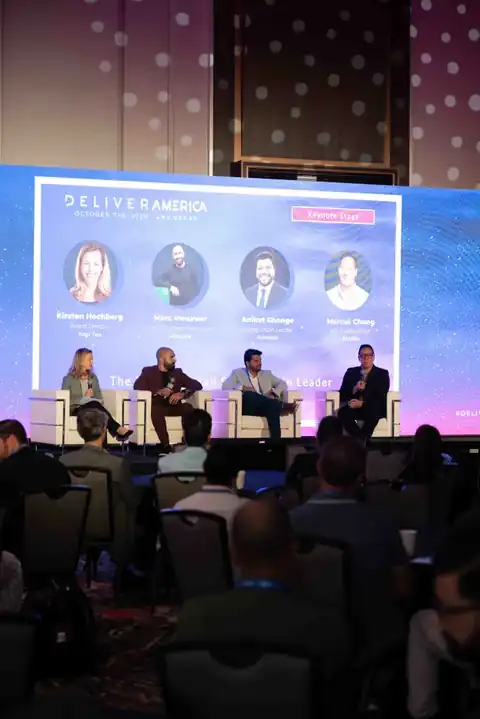
Rakesh Joshi, Senior Director D2C at adidas, shared how shifting consumer behavior is reshaping omnichannel fulfillment and the way brands plan their operations.
“We do demand fulfillment, but the winners will be the ones who anticipate demand, who learn what their consumers want and give it to them before they think they need it,” said Joshi.
Joshi’s keynote, “Winning the Omnichannel Fulfillment Race,” centered on having the right inventory in the right place before demand arrives, and on connecting forecasting, inventory allocation, and execution across Click & Collect and Ship from Store. Planning around where demand is heading, rather than where it has been, was a theme that ran through the omnichannel discussions.
Peak season was the practical test. A panel titled “Peak Season Without a Crystal Ball” brought together leaders from Mejuri, Rethink Retail, and NETGEAR, along with Pauke Corstens, a former VP at Walmart, Wayfair, and Groupon. With Black Friday close, they covered forecasting, inventory positioning, labor planning, and promotions, and what teams could still change to reduce risk before peak hit.
Parcel and Last-Mile Costs: Where Margin Quietly Leaks
Several sessions focused on the gap between the delivery costs shippers plan for and what they actually pay. An EasyPost session description argued that carriers changed how they charge in 2026, not just how much. USPS shrank its dimensional divisor so the same box bills nearly 20 percent heavier, surcharges climbed faster than base rates, and peak now runs four months. The session offered a three-step way to pressure-test a decision, such as a carrier switch or packaging change, against your own shipments with a small pilot before rolling it out.
Related sessions covered multi-carrier orchestration, with Maersk’s head of e-commerce for North America on connecting carrier selection, delivery economics, and visibility behind one delivery promise. FreightFox looked at AI-driven invoice matching to catch duplicate and inflated freight charges, and a St. Onge session asked why the last mile is still hard when so much has been invested in automation, routing, and robotics. For shippers, the common thread is to compare what you are billed against what you planned, and to test any change on a small slice of volume before committing to it.
AI With Proof, Not Hype
AI ran through the program, but the tone was practical. A roundtable called “AI With Proof” asked leaders to compare what has measurably changed across forecasting, planning, inventory, labor, and fulfillment, what is still stuck in pilot mode, and what it takes to redesign workflows. Another explored how supply chain professionals without engineering backgrounds are building production AI systems themselves, and the governance and safeguards that requires.
Deborah Dull, author and founder of the Circular Supply Chain Network, opened the event and delivered a day-two keynote drawing on her book Self-Driving Supply Chains, outlining a five-step framework for moving past fragmented technology initiatives. MIT’s Center for Transportation & Logistics shared findings from its fifth annual survey of more than 600 supply chain leaders on how stores support omnichannel fulfillment and how AI is moving toward end-to-end orchestration. Another keynote noted that AI skills in supply chain job postings are up 387 percent since early 2023, while arguing that the harder leadership challenge is cross-functional influence and knowing where human judgment still matters.
Moving Decisions Upstream
DP World’s global retail vertical lead made the case for acting earlier in the chain. Purchase order visibility and closer coordination with suppliers can give retailers more options before goods are committed, such as consolidating or redirecting shipments, prioritizing inventory, or switching transport modes.
Other operational sessions went deep on economics. A Rohlik roundtable, “Can Same-Day Delivery Actually Make Money?”, unpacked delivery P&L, the trade-off between speed and drop density, and which fixed costs are truly avoidable, offered as a European reference point rather than a template. Slip Robotics focused on the loading dock, citing truckers spending 23 percent of their workday idling there and a quarter of warehouse injuries occurring at the dock.
A Planning Checklist for 2027
Sessions emphasized practical examples over abstract predictions. The topics practitioners spent time on make a useful checklist for your own planning:
- Tariff exposure, sourcing flexibility, and scenario planning
- Parcel and freight cost audits: billed versus planned
- AI in live operations, and which projects have measurable results
- Retail network redesign and new network models changing shipper expectations
- Peak-season readiness and inventory positioning
- Upstream visibility into purchase orders and supplier timelines
- Winning the omnichannel fulfillment race
Questions to put in front of your own team: Where do your actual parcel costs differ from your plan? Which AI projects have moved past the pilot stage? Does your network still match how customers buy? How early does peak planning start, and what do your carriers and partners now expect from you?
The thread worth carrying into your planning: fulfillment is no longer a back-office function, and the retailers and brands that treat it as a competitive advantage are the ones setting the pace.